This page describes Recalbox 11.0, available only to patrons through the
patronchannel.
11.0 is the biggest update in Recalbox history. Online play has been rethought from scratch, the media centre gives way to Recalbox TV, force feedback wheels arrive, and 33 new systems join the family — five legendary arcade boards among them.
¶ Recalbox Online
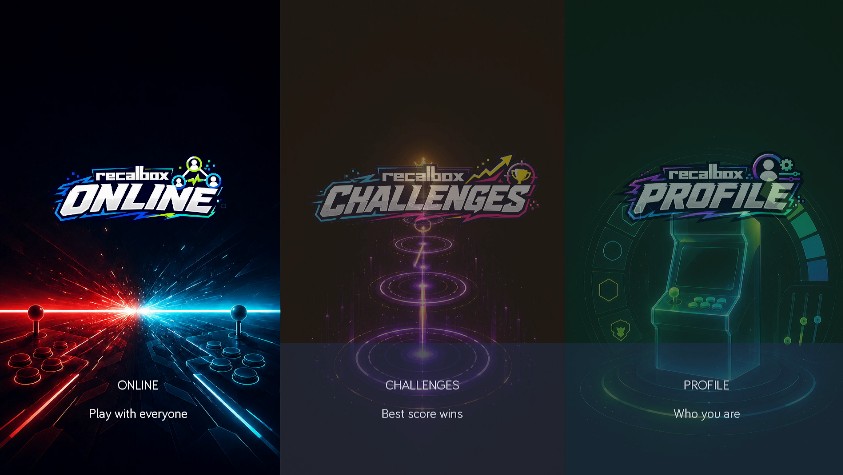
Face Recalbox players from all over the world, straight from the frontend, in a dedicated virtual system.
It is all visible from the website too: Recalbox Online and its seven-step walkthrough, the rooms open right now and the cups being played.
-
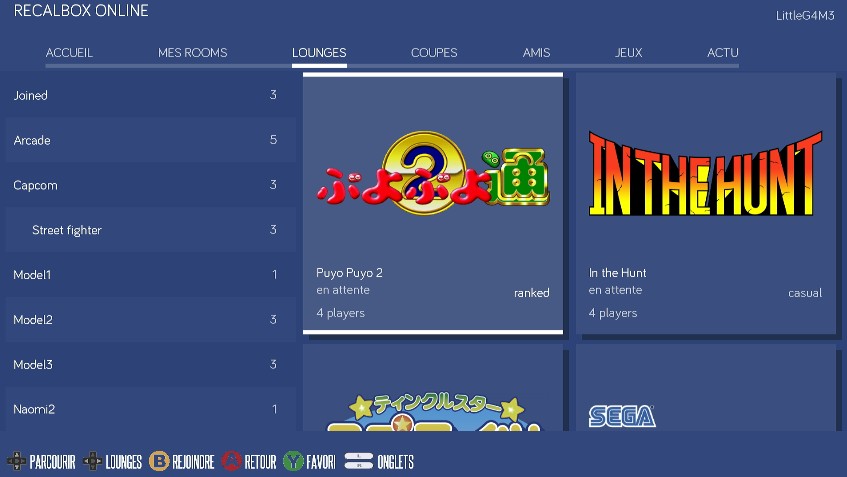
Rooms per game, public or reserved for friends, grouped into themed lounges (arcade, Capcom, SNES…). As soon as two players are ready, the game launches on its own.
-
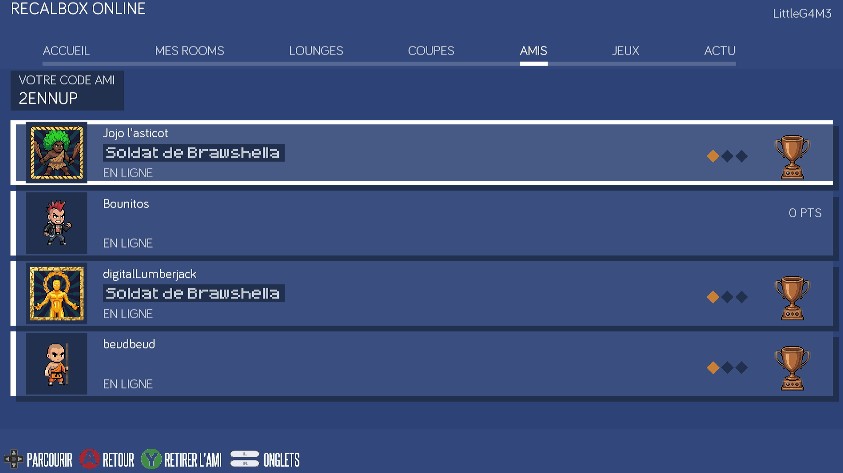
One ID per player, friends and invitations. A match offer reaches you anywhere in the interface, announced by "Here comes a new challenger".
-
Without going through the virtual system: from the game list, pick a game, press the
Recalbox Onlinebutton, invite your friend, and off you go.
-
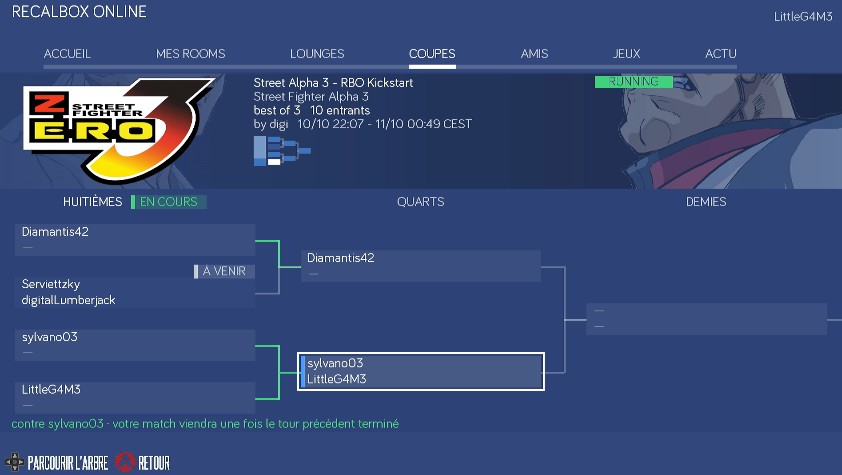
Ranked matches — points per game, a global rank, stars to win — and cups with a bracket and a podium, at a set time or at the time players vote for.
-
Matches are streamed live as video, for as many viewers as want to watch, and cups can be watched again.
-
A profile with titles, avatars and cards, plus a patron area gathering cards, badges, goodies and the jukebox.
-
Linked arcade games, one player per Recalbox and up to eight machines: Virtua Racing, Daytona USA, Sega Rally, Scud Race, Initial D, Club Kart, OutTrigger and Ferrari F355 Challenge Twin.
-
Naomi and Atomiswave versus games — Marvel vs. Capcom 2, Capcom vs. SNK 2… — with rollback to cut input delay.
-
Your network configures itself to keep latency as low as possible, and a logo in the game lists marks the games that play online.
¶ Recalbox TV
The new media centre replaces Kodi. It is built for the pad, on HDMI as much as on a CRT.
The Recalbox TV page covers it all: adding a source, naming your files well, the settings.
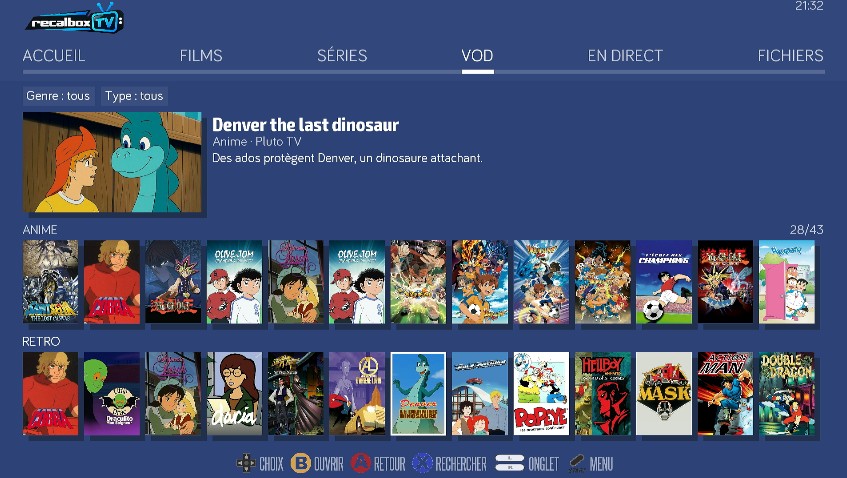
- Sources: network shares detected automatically, a drive plugged into the Recalbox, Plex, Jellyfin and DLNA servers, Pluto TV, Crunchyroll (with an account), IPTV channel lists, a Freebox's live TV with its programme guide, and followed Twitch channels on Raspberry Pi 5.
- A library that recognises films and series through TMDB and TheTVDB, sorted by genre, decade and source.
- Resume where you stopped, the next episode following on, watched films ticked off.
- A single search from the
STARTmenu, across the library, Pluto TV and Crunchyroll. - Your TV's remote drives Recalbox over the HDMI cable.
- Films keep their own rate, automatically over HDMI. On a CRT, a setting offers a film mode when the screen has one: 24, 48 or 72 Hz — with 48 Hz on an RGB Dual.
¶ Recalbox Challenges
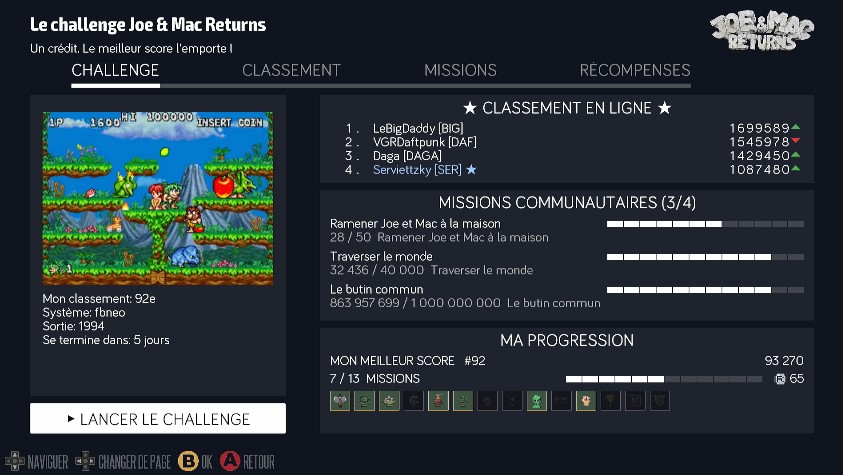
The challenges are public: the fortnight's challenge with its leaderboard, every challenge played so far and the season standings.
- Every mission shows the trophy it earns, and every reward the badge you will actually wear.
- A run cleared without a continue is stamped 1CC.
- Missions appear in your Recalbox's language, and each challenge shows how long is left to play it.
- Every run stays in the history with its replay, and a refused run says why.
- Your friends are highlighted in the leaderboards.
¶ 33 new systems
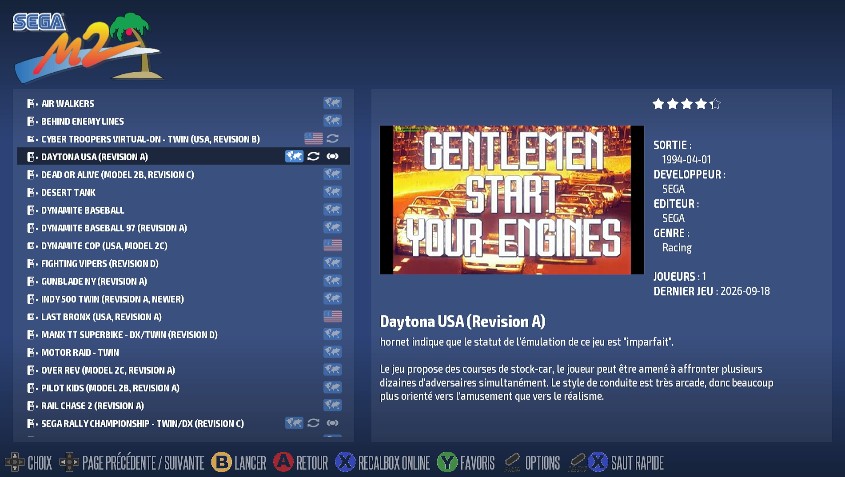
Arcade — Sega Model 1, Sega Model 2, Namco System 22, SNK Hyper Neo Geo 64 and Aleck 64.
Consoles and handhelds — Nokia N-Gage, Tiger Game.com, Bit Corp. Gamate, Casio Loopy, Casio PV-1000, Gamepark GP32, VTech V.Smile, Funtech Super A'Can, Atari Jaguar CD, Emerson Arcadia 2001, Interton VC 4000, CreatiVision, MyVision and the PONG AY-3-85XX family.
Computers — Acorn Archimedes, Matra Hachette Alice, APF M-1000 & Imagination Machine, Enterprise 64/128, Fujitsu FM-7, FM Towns, FM Towns Marty, NEC PC-6001, Sharp MZ, Sord M5 and Tomy Pyūta.
Game engines — Godot Engine (Raspberry Pi 4, Pi 5 and PC) and BennuGD, plus a new port: Jazz Jackrabbit 2.
On top of that, picoarch: a lighter alternative to RetroArch that leaves more power to the emulator, selectable in the LIBRETRO FRONTEND menu.
¶ Arcade and CRT screens
- DUAL OUTPUT: on a Raspberry Pi 5 fitted with a Recalbox RGB Dual 2, an RGB JAMMA or a JVS, the CRT picture also shows on an HDMI screen, in three styles (smoothed, scanlines, sharp pixels). Turn it on with
CLONE SCREEN ON HDMIin the board's menu. - R, G and B levels are set straight from the board's menu.
- RGB JAMMA: every board shares the same input driver, with combos, debounce, per-game remaps and autofire; the board is detected more reliably at boot.
- JVS: racing cabinets get their controls remapped game by game.
- Sega Model 1 and Model 2 display sharp and well framed at 15 kHz.
¶ Force feedback wheels
- Force feedback on Logitech G29 and G923, Fanatec CSL DD, Gran Turismo DD Pro, ClubSport DD and CSL Elite (base in PC mode). Experimental: Fanatec ClubSport V2 and V2.5, Podium DD1 and DD2, CSR Elite and Porsche 911.
- A Wheels virtual system gathers the arcade games played with a wheel — Out Run, Daytona USA, Pole Position — to be enabled in virtual systems.
- A wheel menu with a test screen, strength and effects adjustable per system and per game, and a wizard the first time a wheel is plugged in.
¶ Lightguns
Gun4IR lightguns are supported — see lightguns in Recalbox.
¶ Emulators
- Sega Model 3 also runs on the Supermodel libretro core v0.9.1, faster and with fixed 3D, alongside the standalone emulator.
- MAME 0.287 joins 0.278: every game launches with the version it needs. The cores are now called
mame_latestandmame_old, andmame2003is gone — its games move tomame2003-plus. The matching.datfiles are on the Arcade romsets and .dat files page. - New Texas99 (TI-99/4A) and SM510 (Game & Watch) cores.
- Philips CD-i:
same_cdiupdated, runs on Raspberry Pi 5 and handles FMV games. - Virtual Jaguar moves to 3.7.0 and supports the Jaguar CD.
- Naomi, Naomi GD and Atomiswave play over netplay with
flycast-next; Naomi 2 runs on Vulkan on the Pi 5, HDMI included, at full speed. - GameCube and Wii on a CRT: the screen follows the game when it switches between 50 and 60 Hz.
- HatariB loads hard disk images, Visual Pinball handles multi-screen and an external DMD, Solarus moves to 2.1.3.
¶ PC and Steam Deck
- On dual-boot machines, Recalbox reboots on its own after a gaming session.
- Steam Deck: the built-in pad is mapped properly, screenshots work again, and the picture goes to the TV when it sits on its dock.
¶ Frontend
- Two new tabs: INFORMATION, which gathers everything about your machine on one screen (board, processor, memory, display, sound, network, pads, CRT adapter), and HEALTH, which warns you about disk, temperature, power, clock, network shares or memory trouble.
- "Create a support archive" sends the archive to the team, and a four-character code finds it again.
- The scraper finds the right game even when the filename is wrong, including inside a 7z archive or on a read-only USB stick.
- New logos and overlays for Namco System 22, Hyper Neo Geo 64, Aleck64, Sega Model 2 and Jaguar CD.
- A dot matrix display (DMD), ZeDMD included, over USB or Wi-Fi, shows the selected system and game.
¶ System
- Raspberry Pi 4 and 5: 3D games run faster; on the Pi 4, Sega Rally 2 now reaches full speed.
- Sound no longer vanishes at boot: an output that failed or was unplugged comes back on its own, and every sound card carries its real name.
- A keyboard encoder you set up by hand, such as an X-Arcade panel, is recognised again.
- Console mode has a new BIOS-style boot video.
¶ Going further
- What's new in Recalbox 10.1 — the previous release
- Update manager — the
stableandpatronchannels - Becoming a patron — what patron access brings, and the tiers on the website
- Supported systems — the public list, updated with every release