Arcade is the most demanding family of systems in Recalbox: an arcade game only launches if your romset matches the emulator's version. This page gives you the keys to understand why — and to make the right choices.
¶ The arcade cabinet
The 70s mark the beginning of arcade history. Each cabinet used specific, unique hardware, often with several processors, very special sound and video chips, and always the best display technology of the moment. The first cabinets were dedicated to a single game (Pac-Man, Space Invaders, Pong…): when a game reached the end of its commercial life, reusing the cabinet was laborious.
Around 1986, arcade systems evolved: a generic motherboard coupled with a game cartridge or a PCB (JAMMA connector). Cabinets became generic, the hardware got closer to a home console or a high-end computer — lower production costs, easier life for arcade operators.
Many arcade systems nonetheless kept specific hardware optimized for a single game: racing games, light gun games, dance games…
¶ The emulators
There are two big families of arcade emulators, each with its pros and cons: MAME and FinalBurn Neo.
¶ FinalBurn Neo
FinalBurn Neo (or FBNeo) is an arcade emulator simpler to approach than MAME: it emulates the same great classics with fewer required dependencies, and its romset is more stable over time.
¶ MAME
MAME (Multiple Arcade Machine Emulator) is a preservation project: documenting decades of hardware and software to prevent this "vintage" heritage from being lost and forgotten.
¶ MAME's documentation
Making the documentation usable (playable!) mainly serves to validate its accuracy — how else to prove the hardware was faithfully recreated? Over time, MAME absorbed its sister project MESS in 2015: it now documents a wide variety of computers, consoles and calculators, on top of the arcade games that were its initial goal.
The first public version (0.1) of MAME, by Nicola Salmoria, was released on February 5, 1997. Version 0.140 (2010) supported more than 4,510 games; version 0.220 (2020), more than 6,000 games and machines.
As MAME constantly evolves, its romset must evolve along with the emulator's version.
¶ The dump principle
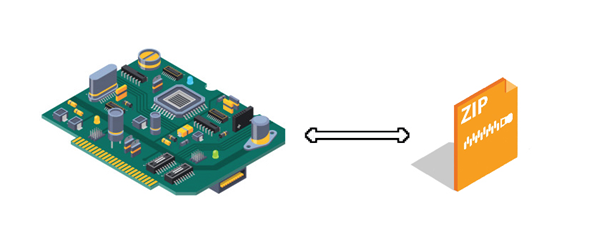
MAME documents this library of machines through dumping: transferring the data contained in the various components (motherboard, PCB, cartridges) to a digital format usable by emulators.
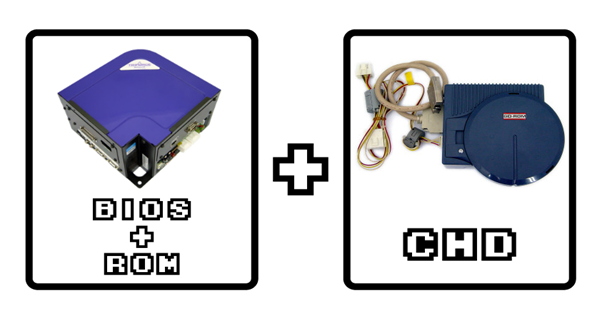
For some machines, this documentation comes with a CD-ROM, DVD or hard drive medium, called a CHD (Compressed Hunks of Data). Without this CHD, emulation will be imperfect — or will not start at all.
This documentation is not always perfect: some games only exist as "BAD DUMP" versions, with imperfect or impossible emulation.
¶ Romsets
¶ Contents of a romset
A MAME romset documents far more than arcade games. With tools like Romulus or clrMamePro, you can inventory a romset against a reference file: the .dat file, which lists the exact contents of the romset matching one emulator version.
Always compare your romset with the .dat file of your version, and avoid picking roms left and right: it is the first cause of games that will not launch.
In MAME, you will find the following families:
- STANDARD: the biggest part of the romset — arcade games, pinball machines, consoles, slot machines, calculators, even tamagotchis…;
- MECHANICAL: electromechanical machines, hard to emulate as they are half mechanical, half digital;
- DEVICE: files describing shared hardware components, needed to emulate some machines;
- BIOS: the systems with common BIOSes (about 70).
¶ Dependencies
Some games require dependencies: BIOSes or drivers. The best-known case is the Neo-Geo:
- Neo-Geo: copy the
neogeo.zipBIOS file into the same directory as your games; - CPS: some CPS games require the
qsound_hle.zipdriver in the same directory.
If you sort your games into subdirectories, copy the BIOSes and drivers into every subdirectory containing games that need them — they are small, do not hold back.
Where to find these files? In your romset! To know whether a game needs dependencies, check the excellent Arcade Database by Arcade Italia: search by file name, then click Show MAME Required Files selecting the version range of your romset.
¶ CHDs
This part mostly concerns MAME: there are no CHDs with FinalBurn Neo.
Like a BIOS, the CHD must accompany its rom — but its layout is specific: the (uncompressed) .chd file must be placed in a folder bearing the exact name of the rom (without extension), next to the rom's .zip.
Example for sfiii3 (Street Fighter III 3rd Strike):
┣ 📁 roms
┃ ┣ 📁 mame
┃ ┃ ┣ 🗒 sfiii3.zip
┃ ┃ ┣ 📁 sfiii3
┃ ┃ ┃ ┣ 🗒 sfiii3.chd
These CHD files are rarely shipped with romsets, as they are big.
¶ Parents, clones and BIOSes
- PARENT: the rom of the "original version" of a game according to the MAME team — usually the most recent revision, in international (World) or US version. BIOSes aside, it contains everything the game needs to run.
- CLONE: a variant of the same game (Street Fighter II Turbo is a clone of Street Fighter II Champion Edition) — regional versions, bootlegs, hacks…
- BIOS: the rom common to all games of one machine (Neo-Geo MVS…), containing the machine's startup programs.
¶ Romset types: split, non-merged, merged
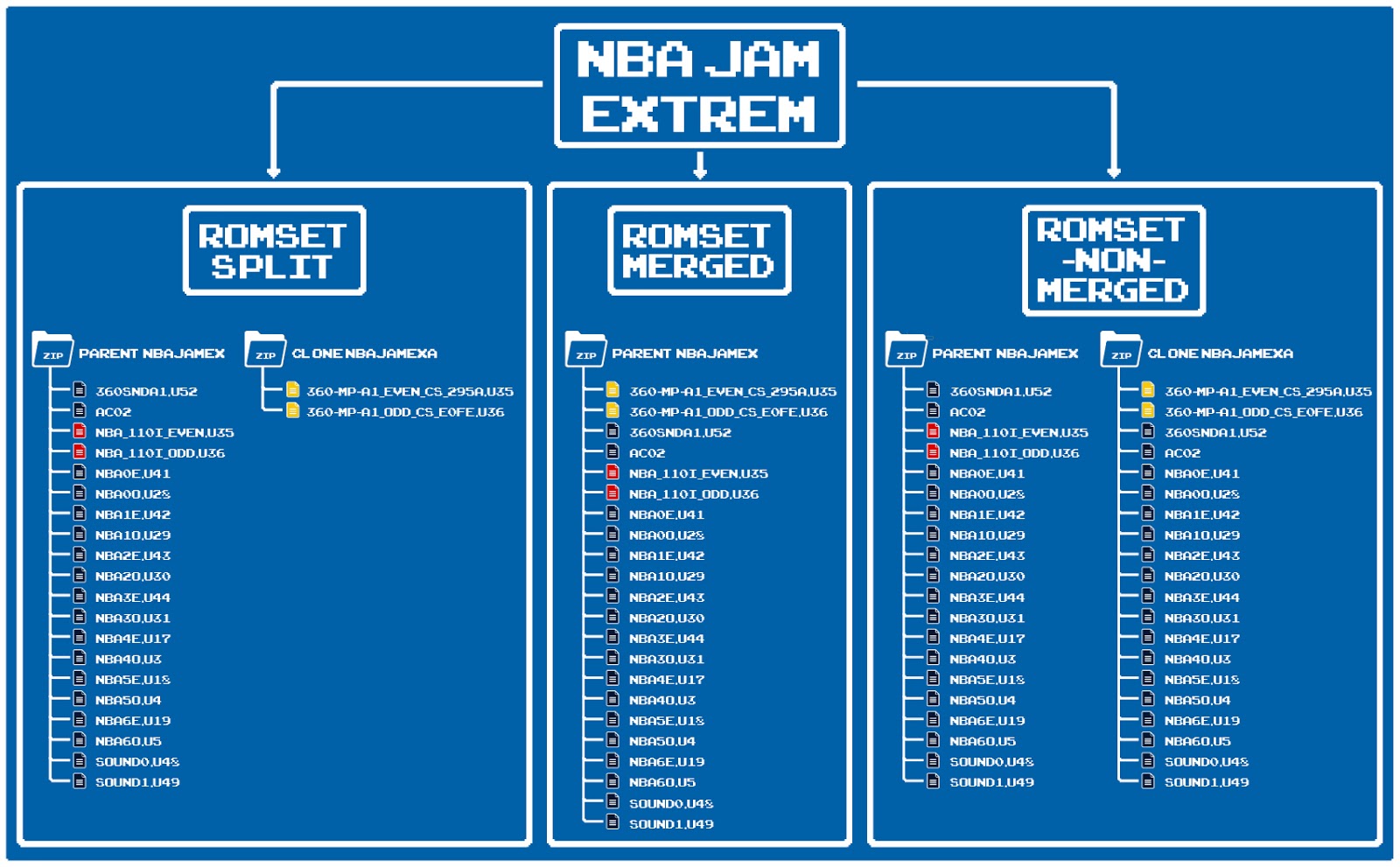
- Split: the files shared between parent and clones are only in the parent's zip — to use a clone, you need both files, parent and clone.
- Non-merged: each clone zip contains everything needed, it is self-sufficient.
- Merged: parent and clones are gathered in the same zip.
¶ Arcade and Recalbox
Recalbox offers several arcade emulators and cores — FinalBurn Neo, several generations of MAME (from historical versions like MAME 2003 Plus to recent ones) and AdvanceMAME — each tied to one precise romset version. The most powerful machines (PC, Raspberry Pi 4 and 5) also get the recent MAME versions; on Raspberry Pi 5, the old intermediate versions were removed, as recent MAME runs every game there.
You will find the romset version expected by each core on the pages of the Emulators > Arcade section, along with the dedicated systems (Neo-Geo, Naomi, Atomiswave, Model 3…).
Two tips to organize several romsets:
- inside the
mamefolder, a subfolder named after a core (mame2003+,mame2010…) automatically selects that core for its whole contents; - for freely-named folders, use a configuration override.
And to display all your arcade games in a single system (or by manufacturer), see the arcade virtual system.
¶ Making an arcade list readable
A full MAME romset mixes the parent game, its dozens of regional clones and bootlegs, the bios files and the sets the emulator cannot run. This is the number one source of confusion for arcade newcomers. Four options in MAIN MENU > SYSTEM-LISTS & GAMELISTS SETTINGS, ARCADE GAMES section, clean this up:
ENABLE ENHANCED VIEW— parents and clones sorted hierarchically, with more information displayed;FOLD CLONES BY DEFAULT— one game = one line; unfold on demand withHK+→, fold back withHK+←;HIDE BIOSandHIDE NON-WORKING GAMES— remove from the lists everything that is not playable;ALWAYS USE OFFICIAL NAMES— shows titles from the official databases rather than set names.
ALWAYS USE OFFICIAL NAMESoverwrites the names you may have edited by hand and those coming from the scraper.
¶ Glossary
A
- AtomisWave: arcade system created by Sammy, with an architecture similar to Sega's Naomi.
B
- Boot: the startup phase of a system (arcade board, console…).
- Bootleg: unofficial copy of a game on PCB or cartridge, usually sold much cheaper than the original, recognizable by the near-total absence of the publisher's branding. Bootlegs often suffer from assorted bugs: missing music or sound effects, random freezes…
C
- Motherboard: the board holding all the computing components (the hardware), needed to run the games plugged into it — cartridge or disc (the software).
- Chihiro: arcade system released by Sega in 2002, based on the architecture of Microsoft's Xbox. Popular games: Outrun 2, House of the Dead 3, Virtua Cop 3.
- CPS 1 (Capcom Play System 1): Capcom arcade system released in 1988. Street Fighter II is its most famous game.
- CPS 2: Capcom arcade system released in 1993 — Gigawing, Marvel vs Capcom, the Street Fighter Zero/Alpha series, Vampire Savior, Progear no Arashi…
- CPS 3: Capcom arcade system released in 1996, very powerful in 2D — Jojo's Bizarre Adventure, Warzard, the Street Fighter III series.
- Crystal System: JAMMA arcade system released in 2001 by BrezzaSoft (former SNK employees), meant to replace the Neo-Geo on the low-cost arcade market. A commercial failure — very few games, including Evolution Soccer and Crystal of the Kings.
D
- DECO Cassette System: system developed by Data East, released in 1980 — the first arcade system letting operators change games, delivered on audio cassettes with a security dongle (one of the earliest forms of DRM).
- Dump: the technique of transferring the data of an arcade game's ROMs to a computer file (ROM image), then usable by emulators like MAME.
E
- Emulation: the process of reproducing on one machine the behavior of another device, thanks to an emulator.
H
- Hyper Neo-Geo 64: 64-bit successor of the Neo-Geo MVS, created by SNK in 1997 for 3D. Only 7 games, including Fatal Fury: Wild Ambition and Samurai Shodown 64.
I
- ROM image: copy of the ROMs (the electronic components of cartridges and arcade boards holding the game), usually compressed as
.zip, readable by emulators. For simplicity, they are just called "roms".
J
- JAMMA: connector standard created in the mid-80s by the "Japanese Amusement Machine Manufacturers Association" so every game works on every cabinet: two 8-way joysticks, two start buttons, six control buttons (three per player), mono sound.
K
- Konami System 573: series of Konami arcade boards based on the PlayStation, mostly used for Bemani music games — including Dance Dance Revolution, introduced in 1998.
- Konami Viper: JAMMA+PCB system launched by Konami in 1998 — 13 games, including Jurassic Park 3, GTI Club 2, Silent Scope EX, Thrill Drive II.
L
- Lindbergh: Sega arcade system released in 2006, with an architecture close to a PC — Virtua Fighter 5, Virtua Tennis 3, House of the Dead 4, After Burner Climax… Named after Charles Lindbergh, the first aviator to cross the Atlantic solo.
M
- MAME: the famous emulator documenting more than 6,000 machines — a true virtual museum of arcade gaming.
- Model 1: Sega arcade system released in 1992 — Virtua Racing, Virtua Fighter.
- Model 2: Sega arcade system released in 1993 — Daytona USA, House of the Dead, Sega Rally Championship, Virtua Fighter 2.
- Model 3: Sega arcade system released in 1996, the most powerful of its time — Daytona USA 2, Scud Race, Sega Rally 2, Virtua Fighter 3.
N
- Namco System 246: arcade system based on the PlayStation 2, created by Namco in 2001. Evolutions: System 256, Super System 256, System 147.
- Naomi / Naomi GD: cartridge and GD-ROM system released in 1998 as the Model 3's successor. Acronym of New Arcade Operation Machine Idea — "Naomi" also means "beauty" in Japanese.
- Neo-Geo MVS (Multi Video System): JAMMA-compatible arcade system created by SNK in 1990.
- Nintendo PlayChoice 10: based on the NES, with up to 10 games installed at once. Coins buy play time rather than credits, with on-the-fly game switching.
P
- PCB (Printed Circuit Board): in arcade, the board containing a game, plugged into the cabinet through the JAMMA connector.
- PGM (Poly Game Master): arcade system developed by IGS, similar to the MVS in performance and use.
- Pinball: pinball machine.
R
- ROM (Read Only Memory).
S
- Sega Hikaru: Sega system from 1999, the first arcade system capable of Phong shading, designed for the game Brave Fire Fighters. Only six games — too costly compared with the Naomi 2.
- Sega Mega Play: arcade system based on the Megadrive/Genesis — coins buy credits, like a standard cabinet.
- Sega Mega-Tech: arcade system based on the Megadrive/Genesis — coins buy play time.
- Set: in arcade parlance, a game or BIOS made of multiple ROMs.
- ST-V Titan (Sega Titan Video): Sega arcade system launched in 1994, with an architecture identical to the Saturn's (but cartridge-based), to enable fast, faithful arcade ↔ console conversions.
T
- Triforce: system jointly developed by Nintendo, Sega and Namco, released in 2002, based on the GameCube's architecture — F-Zero AX, Virtua Striker 4, Mario Kart Arcade GP. The name evokes the three companies' alliance… and The Legend of Zelda.